
Runnels County Arrest Warrants Explained
Under Texas Code of Criminal Procedure Chapter 15, an arrest warrant is a written order from a magistrate telling a peace officer, or a named person, to bring someone in. Any Runnels County warrant can come from a district, county, JP, or municipal judge, so long as the case falls inside that court's jurisdiction. Where you file your question depends on the charge, not on where you live. A felony belongs with the 119th District Court or the District Clerk. A county-level misdemeanor goes to the constitutional County Court or the County Clerk. A city ticket or precinct matter stays with its municipal or JP court. The Sheriff serves papers, sure, but the public Sheriff page is not a case search, so skip it for status questions and go straight to the right clerk in Runnels County.
Runnels County Arrest Warrant Complaint
Everything starts with a sworn complaint laying out the facts of an alleged offense for a magistrate. Chapter 15 lets a judge issue a warrant when the law allows and the required showing is made. The order must name the person, or give a reasonably definite description, state the offense, and bear the magistrate's signature and office. That route is different from what happens after a missed hearing. A bench warrant grows out of a case already on file, not a fresh complaint in Runnels County. Before you plan anything, ask the clerk which order was entered, on what date, and under what case number.
Inside a Runnels County Arrest Warrant
A warrant record can carry a warrant or cause number, issue date, offense, complaint reference, issuing magistrate, bond terms, service status, and holding agency. Runnels County publishes no sample listing or number format. Ask the clerk for those fields by name rather than expecting an online screen.
| Warrant / cause number | Connects the order to the court case; local formats were not posted. |
|---|---|
| Offense and basis | Names the charge and complaint or affidavit reference. |
| Magistrate | Shows which authorized judge signed or ordered the process. |
| Bond and status | Ask whether bond was set and whether service is pending or complete. |
| Agency | May identify sheriff, city police, or constable if shown in that court record. |
The Runnels County Felony Capias Route
Once a felony indictment lands, Texas Code of Criminal Procedure article 23.03 tells the District Clerk to issue a capias unless the State asks for a summons instead. That capias goes to the sheriff where the defendant lives or can be found. Skip a court date after a summons and a capias may follow. This district route is separate from the capias pro fine a JP or city court issues over an unpaid Class C judgment. For any district file, call the Runnels County District Clerk at 325-365-2638 and ask whether the record shows a warrant, capias, or summons. The court's page and the Clerk's page post separate contact routes, and neither lists a walk-in warrant counter.
Serving Arrest Warrants in Runnels County
Who actually serves a warrant depends on the case. The list of possibilities includes the Runnels County Sheriff, Ballinger Police, Miles Police, Winters Police, and the county constables. No office maps each warrant to a particular officer, so let the court record tell you the next call. City police handle their municipal cases, while the Sheriff works countywide as a fallback. After an arrest, the person is booked, then taken before a magistrate to hear the accusation, rights, and a bond or release decision. No published schedule covers Runnels magistration, bond amounts, or jail surrender hours, so ask the issuing court or your lawyer about a voluntary appearance. The District Clerk's official page names the office holding the district case file, and its staff can point you to the right court contact for an arrest-warrant record.
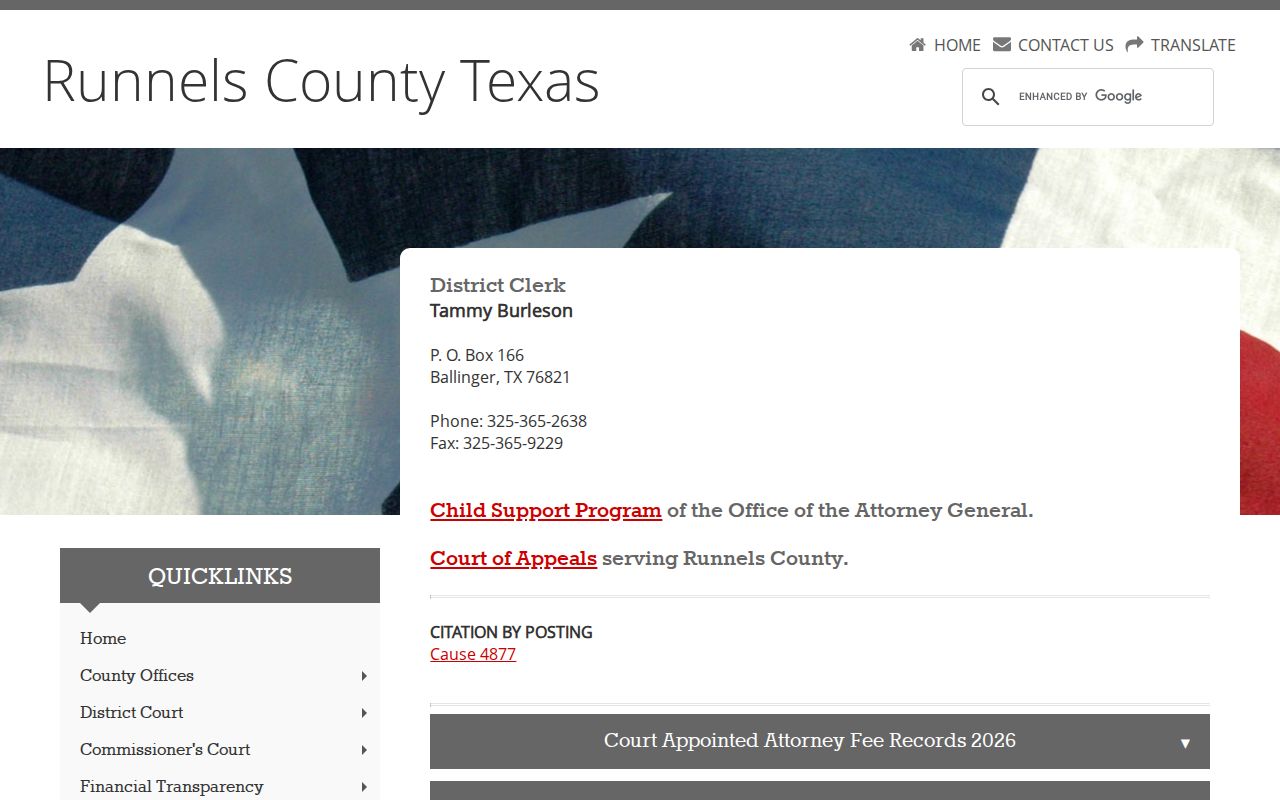
The District Clerk's contact material leads to a court file. It is not a roster of names or open Runnels County warrants.
Runnels County Warrant-Issuing Magistrates
Several judicial officers can issue arrest process in Runnels County: district and county judges, justices of the peace, municipal judges, and other authorized magistrates, each within their jurisdiction. The 119th District Court takes felony matters. The constitutional County Court hears Class A and B misdemeanors, while JP and municipal courts take most Class C, traffic, and ordinance cases. Texas Judicial Branch material lays out this hierarchy, and the public Judicial Directory and OCA directory can locate a court or staff member. Neither directory shows private case status or confirms an active warrant.
Comparing Arrest, Summons, and Bench Warrants
Each paper does a different job. An arrest warrant orders an officer to take someone into custody. A summons tells a person to appear, without that arrest command. A bench warrant ties to a missed setting or court order in an existing case, and a felony capias is its own post-indictment process in Runnels County.
| Process | Why it may issue | Where to confirm |
|---|---|---|
| Arrest warrant | Probable-cause complaint or statute | Issuing magistrate’s court |
| Summons | Order to appear in response to a case | Issuing court clerk |
| Bench warrant | Missed date or court-directed return | Court that set the matter |
Runnels County Sheriff Warrant Phone Fallback
The official Sheriff page lists 612 Strong Avenue, Ballinger, and 325-365-2121. It links VINELink and the Jail Roster for custody details, but it shows no warrant fields, no most-wanted list, no warrant unit email, no service hours, bond schedule, or surrender steps. Call to see what the office will confirm, then turn to the issuing court for the legal status of the case. For a copy of an existing record, send a written Texas Public Information Act request to whichever office holds it, with a precise cause number, and expect protected details to be redacted.
If There’s an Arrest Warrant for You
A phone call demanding payment is not proof of a Runnels County warrant. Neither is a name match on some third-party site. Call the clerk instead, confirm the court and cause number, and ask about bond and appearance conditions. If the case is a felony, a family capias, or a bond forfeiture, talk with a Texas attorney before you arrange contact or surrender. Recall and case procedure rest with the court, never with the Sheriff's web page.
Confirm first: Ask the issuing court where and when to appear, whether counsel should arrange it, and how the Sheriff or jail handles the court’s direction.
Get any recall, bond, or new setting in writing from the Runnels County court. A cleared warrant can still leave the charge or court obligation open.
Runnels County Arrest Warrant Record Access
Article 15.26 generally allows public inspection of a warrant and supporting affidavit after execution, subject to confidentiality and other legal exceptions. Sealed records, juvenile arrest warrants, and some active-investigation material can be withheld. A public-information request should name the specific existing record and the court or agency that keeps it.
The official Chapter 15 text is available from the Texas Legislature. Juvenile warrant material has separate protection under Family Code §58.010. Ask for any non-exempt portion and the legal basis for a denial.
The Chapter 15 text is linked from the official Texas statute page.
The statutory source explains warrant requirements, not any one person’s case.